The Lead Masks Case: Brazil’s Strangest Death in Plain Sight
A Hilltop, Two Bodies, and a Note That Should Not Exist
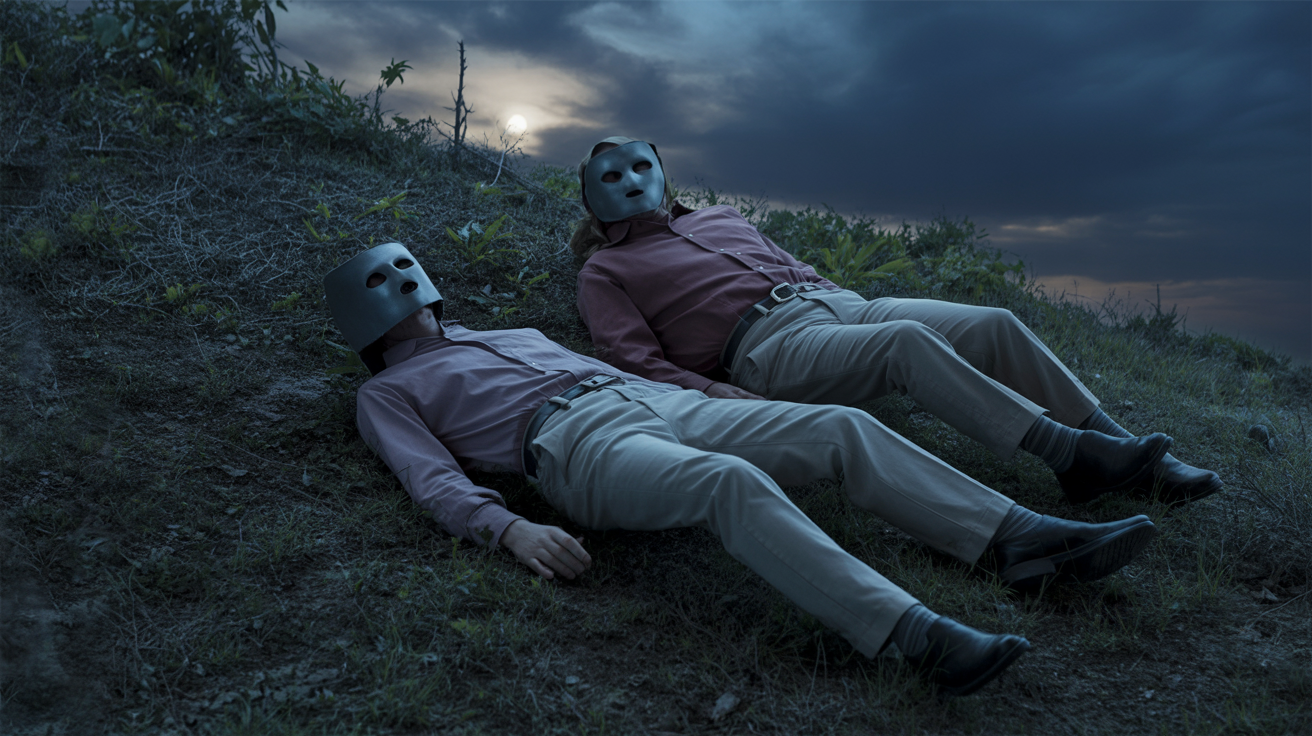
On a warm August day in 1966, a boy flying a kite on Morro do Vintém, a hillside overlooking Niterói, Brazil, discovered something he was not meant to see: two dead men lying in the grass. They were not hidden. They were not badly concealed by the terrain. They were simply there, side by side, dressed in suits and raincoats despite the weather, their faces covered by crude masks made from lead. One had a towel beneath his head. The other carried a small notebook.
The men were later identified as Manuel Pereira da Cruz and Miguel José Viana, both electronics technicians. Their deaths became one of Brazil’s most persistent modern mysteries because the scene looked less like an ordinary crime and more like the aftermath of a private experiment gone catastrophically wrong. The problem, as always in cases like this, is that mystery does not equal evidence. And in this case, almost every explanation leaves at least one major question unanswered.
The Crime Scene That Refused to Behave
Investigators found no signs of a struggle. There were no obvious wounds, no bullet holes, and no indication that the men had been attacked where they lay. Their belongings were intact enough to suggest theft was not the motive. Nearby, police recovered water bottles, a damp towel, and a package containing the lead masks—two oval pieces of material with cutouts for the eyes, resembling makeshift protection rather than ceremonial objects.
Most disturbing was the condition of the bodies. The men had apparently died hours, perhaps days, after arriving on the hill. Yet there was little direct evidence explaining how. Toxicology was limited by the standards of the day, and Brazil in the mid-1960s did not have the forensic capabilities we would expect from a modern death investigation. That limitation matters. A case can become legendary simply because the tools available at the time were not sufficient to close it cleanly.
Still, the objects found with the bodies ensured that speculation began immediately. Why the formal clothing? Why the raincoats? Why homemade lead masks? Why go to a remote hilltop at all?
The Notebook and the Instructions Inside It
The small notebook recovered from one of the men is the reason this case took on a life of its own. It contained a set of terse, oddly specific notes written in Portuguese. The wording has been translated in several ways over the years, but the general meaning is consistent enough to outline:
“16:30 be at the agreed place. 18:30 ingest capsules. After effect, protect metals. Wait for mask signal.”
That is not normal language. It sounds like the sort of shorthand one might jot down before a private test, a spiritualist ceremony, or an illicit chemical experiment. It also sounds like exactly the kind of note that feeds public imagination, because it seems to promise hidden meaning while refusing to provide it.
Some researchers have suggested the men were part of a group experimenting with something they believed could induce a vision or altered state. Others believe the notebook was evidence of a planned suicide pact. A third possibility is that the note was incomplete, misunderstood, or mistranslated after the fact. In mystery cases, those distinctions are important. A cryptic phrase is not automatically a clue. It may simply be the residue of an ordinary plan that became extraordinary only after death.
Possible Explanations, None Fully Satisfying
The most prosaic theory is that the men ingested a toxic substance—perhaps a stimulant, sedative, or compound with unpredictable effects—and died of poisoning or exposure. This is plausible, especially given the limited forensic technology of the time. The lead masks, under this view, were not mystical at all. They may have been an improvised attempt to protect the eyes during some kind of experiment involving bright light, radiation, or chemical reaction.
That explanation is attractive because it does not require a conspiracy. It also fits the fact that both men were electronics technicians and may have had some technical knowledge. But it does not fully explain why they traveled to the hilltop dressed as they were, or why they chose such an odd set of materials.
Another theory places the men in Brazil’s small but active spiritualist subculture of the 1960s. The lead masks may have been intended for a ritual involving messages, ascension, or contact with unseen forces. To be clear, there is no solid evidence that a supernatural event occurred. But there is evidence that people, especially in moments of stress or uncertainty, will construct highly specific private belief systems. In that sense, the paranormal theory may tell us more about human psychology than about ghosts or entities.
A darker possibility is homicide. Could the men have been lured to the hill, drugged, and staged to look like participants in some bizarre rite? That is possible, but again the evidence is thin. A killer would need access, opportunity, and a reason to create one of the strangest crime scenes in Brazilian history. Without a clear motive, murder remains a theory rather than a conclusion.
Why the Lead Masks Case Endures
Cases like this survive because they occupy an uncomfortable middle ground between the explainable and the incomprehensible. They are not ancient legends wrapped in myth. They are modern, documented, and tantalizingly incomplete. There are names, dates, locations, and recovered objects. There is even a note. But there is no final answer that commands universal agreement.
That uncertainty gives the story unusual power. People want the lead masks to mean something. They want a hidden cult, a secret experiment, a government test, a spiritual encounter, anything that transforms a baffling death into a coherent narrative. But coherence is not the same as truth. The temptation to force a story into a neat framework is often what leads investigators astray.
From an analytical standpoint, the case teaches a familiar lesson: when the evidence is fragmentary, restraint is a form of discipline. It is easy to stack conjecture on top of conjecture until a mystery looks solved. It is harder to say, plainly, that the available facts do not support certainty.
A Measured Conclusion
My own view is that the Lead Masks Case most likely involved a dangerous private experiment of some kind—chemical, psychological, or perhaps spiritual in the broad human sense rather than the supernatural one. The scene suggests planning. The note suggests intention. The lack of definitive toxicology leaves room for error, and error may be the simplest explanation of all.
But “most likely” is not “proved,” and that distinction matters. The lead masks remain powerful because they sit at the boundary of documentation and interpretation. They remind us that some mysteries are not solved by declaring them strange. They are solved by following evidence wherever it leads, even when it leads to an unsatisfying answer.
In the end, two men went up a hill in Brazil carrying an idea we still do not fully understand. They never came back. The masks, the note, and the silence they left behind continue to invite speculation. Yet the responsible investigator must hold the line between curiosity and credulity. The truth, if it can be recovered at all, is likely less theatrical than the legend—and far more human.