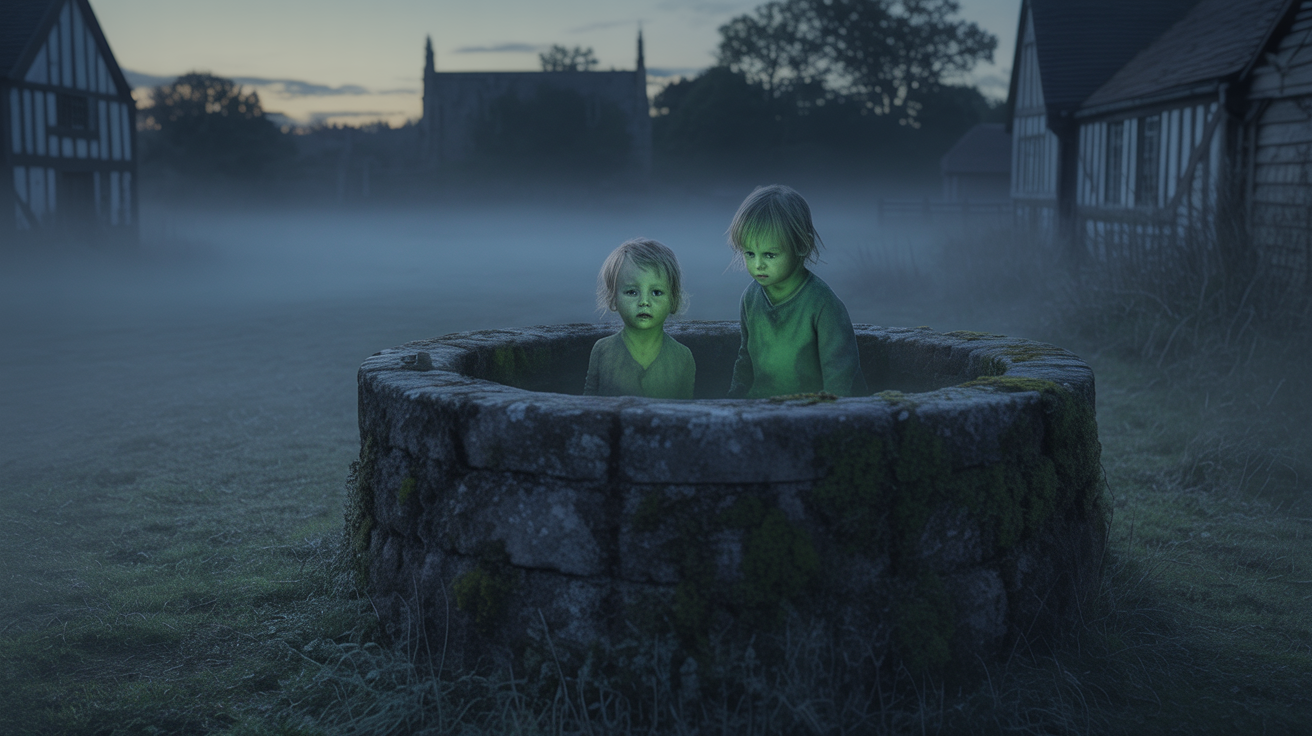
The Green Children of Woolpit: Medieval England’s Alien Encounter or Folklore Gone Awry?
As a former CIA analyst, I’ve learned to separate signal from noise. But sometimes, the signal is so strange, so persistent across centuries, that it demands a closer look. The case of the Green Children of Woolpit is one such anomaly—a medieval mystery that has resisted easy explanation for over 800 years.
The Arrival: A Medieval Anomaly
The story begins in the mid-12th century, in the quiet village of Woolpit, Suffolk, England. According to two near-contemporary chroniclers—Ralph of Coggeshall and William of Newburgh—villagers discovered two children, a boy and a girl, near a wolf pit (from which the village takes its name). The children’s skin was described as having a green hue, their clothing was made of unfamiliar material, and they spoke an unintelligible language.
Initial accounts agree on several key facts:
- The children appeared suddenly, seemingly lost and disoriented.
- Their skin was distinctly green.
- They would eat only raw beans at first, refusing all other food.
- After some weeks, they adapted to normal food, and their skin color faded.
- The boy, reportedly sickly, died soon after baptism. The girl survived, learned English, and eventually integrated into society.
Testimonies and Chroniclers: Parsing the Sources
Both Ralph of Coggeshall (writing in the 1220s) and William of Newburgh (writing in the 1190s) recorded the incident, drawing from local testimony. William’s account is more skeptical, noting the strangeness of the tale but not dismissing it outright. Ralph, meanwhile, claims to have heard the story from "many trustworthy sources." Both agree on the children’s green skin and their initial inability to communicate.
"They were clothed in garments of strange color and unknown material. Their speech was unintelligible to all who heard it." — William of Newburgh, Historia rerum Anglicarum
After learning English, the surviving girl reportedly explained that she and her brother came from a land called "St. Martin’s Land," where the sun never shone and everything was in perpetual twilight. She described a river separating their homeland from another bright land, and claimed they had been herding their father’s cattle when they heard a loud noise and suddenly found themselves in Woolpit.
Analysis: Weighing the Evidence
As an intelligence analyst, I approach such stories with a healthy dose of skepticism. Medieval chronicles are notorious for blending fact, rumor, and allegory. Yet, the consistency of the core details across two independent sources is notable. The green skin, the strange language, and the children’s sudden appearance are not easily dismissed as mere invention.
Possible Explanations
- Medical Hypothesis: Some modern researchers suggest the children suffered from hypochromic anemia (possibly due to malnutrition), which can cause a greenish pallor. Their diet of raw beans could indicate starvation or a lack of familiarity with local food.
- Flemish Refugees: During the 12th century, England saw an influx of Flemish immigrants, some of whom settled near Suffolk. The children’s strange language and clothing might have been Flemish, misunderstood by the locals. The "St. Martin’s Land" could refer to a Flemish settlement or a misheard place name.
- Folklore and Allegory: Medieval stories often used allegory to convey moral or religious lessons. The green children could symbolize outsiders, the dangers of xenophobia, or the transformative power of Christian charity (as the girl thrived after baptism and integration).
- Paranormal Theories: Some have speculated about extraterrestrial origins, parallel dimensions, or fairy folklore. The children’s description of a twilight world and sudden transportation echoes motifs found in both UFO abduction narratives and Celtic fairy lore.
Intelligence Perspective: Assessing Credibility
From an intelligence standpoint, the case presents several red flags:
- Temporal Distance: The events were recorded decades after they allegedly occurred, increasing the risk of embellishment or distortion.
- Lack of Corroborating Evidence: No physical evidence or contemporary records outside the two chroniclers exist.
- Motivations: Chroniclers often sought to entertain, instruct, or reinforce social norms, which could bias their accounts.
Yet, the persistence of the story in local folklore, and the chroniclers’ apparent efforts to verify details, suggest that something unusual did occur. Whether it was a medical oddity, a case of lost refugees, or a misunderstood encounter with outsiders, the villagers of Woolpit clearly believed they had witnessed something extraordinary.
Conclusion: The Enduring Mystery
After reviewing the available evidence, I remain skeptical of supernatural explanations. The medical and refugee hypotheses are plausible, especially given the historical context. Yet, the story’s enduring power lies in its ambiguity. The Green Children of Woolpit remind us that even in an age of reason, some mysteries resist tidy resolution.
My assessment: The most likely explanation is a combination of malnutrition-induced illness and cultural misunderstanding, amplified by the storytelling traditions of medieval England. But as with many enduring mysteries, the lack of definitive evidence leaves the door open—if only a crack—for stranger possibilities. In intelligence work, as in life, it pays to keep an open mind, even as we demand rigorous evidence.