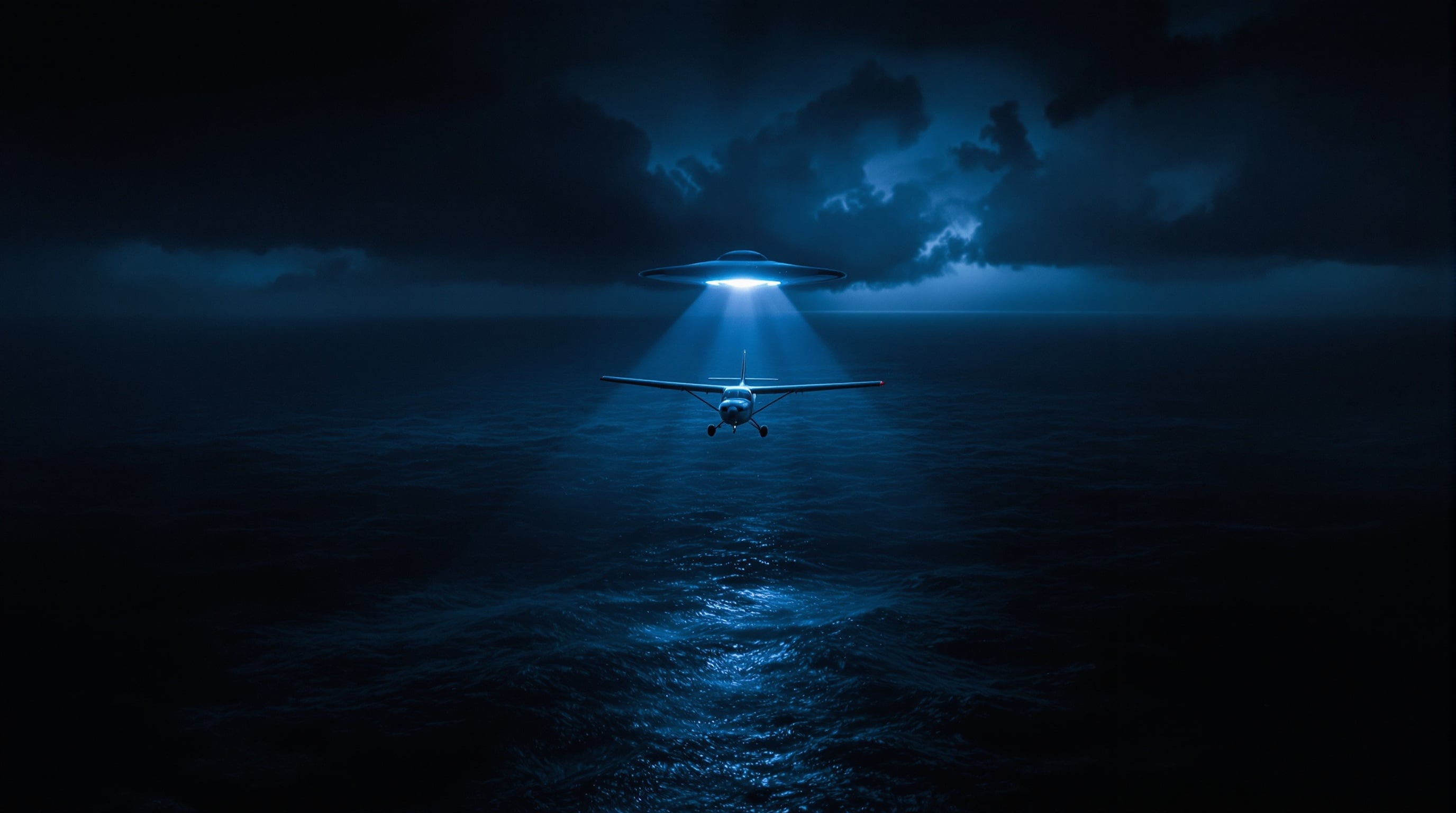
The Disappearance of Frederick Valentich: Vanished Over the Bass Strait
The Night a Pilot Vanished
On the evening of October 21, 1978, Frederick Valentich, a 20-year-old Australian pilot, took off from Moorabbin Airport near Melbourne in a rented Cessna 182L. His intended destination was King Island, a remote outpost in the Bass Strait. He never arrived. What followed was a chilling radio exchange with air traffic control, a sudden loss of contact, and a mystery that has haunted aviation and UFO researchers for decades.
Setting the Scene: The Bass Strait
The Bass Strait, separating mainland Australia from Tasmania, has long been a region of treacherous weather, unpredictable currents, and a history of shipwrecks and disappearances. Valentich’s flight path would take him over these waters at dusk, a time when visibility can be challenging and weather conditions can change rapidly. Yet, Valentich was no novice. He held a Class Four instrument rating and had logged over 150 hours of flight time—enough to be cautious, but perhaps not enough to handle the unexpected.
The Final Transmission
At 7:06 p.m., Valentich radioed Melbourne Flight Service to report an unidentified aircraft “hovering” above him. Over the next six minutes, his transmissions grew increasingly frantic. He described the object as having a “shiny metal surface” and “a green light.” He reported that it was orbiting above him, and at one point, he said, “It’s not an aircraft.”
The final words from Valentich were chilling: “It’s hovering, and it’s not an aircraft.” This was followed by 17 seconds of metallic, scraping sounds before radio contact was lost forever.
The Radio Transcript
- Valentich: “Melbourne, this is Delta Sierra Juliet. Is there any known traffic below five thousand?”
- Flight Service: “Delta Sierra Juliet, no known traffic.”
- Valentich: “I am… seems to be a large aircraft below five thousand.”
- Flight Service: “What type of aircraft is it?”
- Valentich: “I cannot affirm. It is four bright… it seems to me like landing lights.”
- …
- Valentich: “It’s not an aircraft.”
These exchanges, preserved in official records, have fueled speculation ever since.
The Search and the Theories
Search and rescue operations commenced immediately, scouring both sea and land. No trace of Valentich or his aircraft was ever found. The official investigation by the Australian Department of Transport concluded that the reason for the disappearance was “unknown.”
Pilot Error or Disorientation?
One of the most plausible explanations is spatial disorientation. Flying over water at dusk can be disorienting, especially for a relatively inexperienced pilot. The Cessna 182L was not equipped for night flying, and the lack of a visible horizon could have led Valentich to misinterpret lights on the water or in the sky. Some aviation experts suggest he may have become inverted or entered a graveyard spiral, ultimately crashing into the sea.
Hoax or Staged Disappearance?
Another theory posits that Valentich staged his own disappearance. He was known to be fascinated by UFOs and had even expressed concerns about extraterrestrial encounters to friends and family. However, there is little evidence to support this theory. Valentich left behind a girlfriend, a close-knit family, and had made plans for his future. No financial or personal motive has ever been established.
UFO Encounter?
The most sensational theory is, of course, the one Valentich himself seemed to suggest: an encounter with an unidentified flying object. Multiple witnesses reported seeing strange green lights in the sky over the Bass Strait that night, though these accounts surfaced only after news of the disappearance broke. The 17 seconds of metallic noise at the end of the transmission have been interpreted by some as evidence of an encounter with something beyond our understanding.
Examining the Evidence
As a former CIA analyst, I’m trained to look for patterns, inconsistencies, and the weight of evidence. In Valentich’s case, the facts are tantalizing but inconclusive. The radio transcript is authentic and verified. The search was exhaustive, yet no wreckage was ever found. The weather was clear, but the region is notorious for sudden changes. The green lights reported by other witnesses could have been Venus, which was visible in the sky that night, or even reflections from the water.
Yet, the case refuses to be neatly categorized. The metallic sounds on the tape remain unexplained. The lack of debris is unusual, though not unprecedented in ocean disappearances. Valentich’s own words—“It’s not an aircraft”—linger as a haunting epitaph.
The Human Element
What is often lost in the retelling is the human cost. Frederick Valentich was a young man with dreams of a career in aviation. His family, to this day, has no closure. The case is a reminder that behind every mystery is a person, and behind every disappearance, a family left searching for answers.
Legacy and Cultural Impact
The Valentich disappearance has become a touchstone in UFO lore, cited in documentaries, books, and countless online forums. It is one of the few cases where a pilot’s own words, recorded in real time, suggest an encounter with the unknown. For skeptics, it is a cautionary tale about the dangers of night flying and the power of suggestion. For believers, it is compelling evidence that we are not alone.
Conclusion: The Enduring Enigma
After decades of investigation, the disappearance of Frederick Valentich remains unsolved. The evidence is ambiguous, the theories are many, and the truth—whatever it may be—remains just out of reach. As with so many mysteries, the case endures not because of what we know, but because of what we cannot explain. And in that uncertainty, the story of Frederick Valentich continues to fascinate, disturb, and inspire.