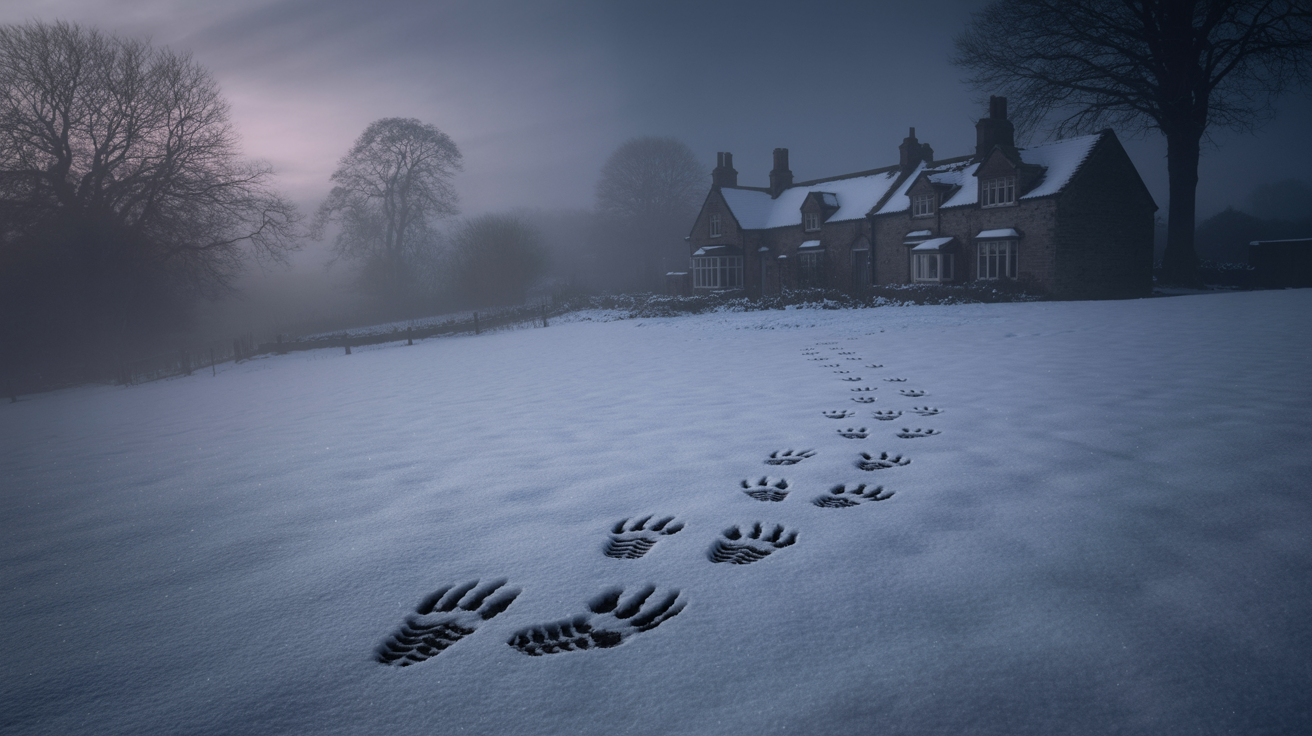
The Devil’s Footprints: A Winter Night of Hooves in Devon
On the morning of February 9, 1855, the residents of Devon, England, awoke to a landscape transformed not just by a heavy snowfall, but by a trail of inexplicable, cloven-hoofed prints stretching for miles across the countryside. The so-called 'Devil’s Footprints' have since become a staple of British folklore, but beneath the layers of legend lies a genuine mystery that has resisted rational explanation for over 160 years.
As a former CIA analyst, I’ve spent my career parsing the improbable from the impossible, searching for patterns in chaos. The Devil’s Footprints case is a masterclass in ambiguity—a phenomenon that, even today, challenges our understanding of both the natural and the supernatural. In this investigation, I’ll examine the original reports, the physical evidence, and the competing theories, applying the same analytical rigor I once used to track terrorist networks to a mystery that has haunted the English countryside for generations.
The Night of the Hoofprints
The events began after a heavy snowfall blanketed Devon on the night of February 8, 1855. By dawn, a single line of hoof-like impressions—each about four inches long and three inches wide, spaced eight to sixteen inches apart—had appeared in the snow. The tracks were not confined to open ground; they traversed rooftops, scaled high walls, crossed rivers, and even continued atop haystacks and narrow garden walls. In some places, the prints seemed to pass through solid obstacles, as if whatever made them had simply walked through closed gates or over high barriers without breaking stride.
Contemporary accounts, collected in local newspapers and private letters, describe the tracks as stretching for over 40 miles, from Exmouth to Topsham, across the Exe Estuary, and through dozens of villages. The prints were so uniform and continuous that many believed they could not have been made by any known animal. Panic and fascination swept the region, with some villagers refusing to leave their homes after dark, convinced that the Devil himself had paid a visit.
Primary Sources and Eyewitness Accounts
One of the most detailed contemporary sources is a letter from Reverend H.T. Ellacombe, vicar of Clyst St. George, who compiled reports from his parishioners and neighboring villages. Ellacombe’s correspondence, preserved in the British Library, describes the prints as “clearly defined, like a donkey’s shoe, but smaller,” and notes their persistence across a variety of surfaces, including snow-covered roofs and narrow garden walls. Other witnesses reported that the tracks sometimes appeared to start or end abruptly, as if the creature had vanished into thin air.
As an analyst, I’m struck by the consistency of these early reports. While folklore often distorts over time, the initial documentation is remarkably sober and detailed. The sheer scale of the phenomenon—dozens of villages, miles of continuous tracks—suggests a genuine event, not a simple hoax or isolated misperception.
Natural Explanations: Hoaxes, Animals, and Weather
Over the years, a variety of natural explanations have been proposed. Some suggest that the tracks were made by a hopping rodent, such as a wood mouse or badger, whose prints were distorted by melting snow. Others point to escaped kangaroos from a private menagerie, or even a wandering donkey or fox. However, none of these animals could plausibly account for the tracks’ uniformity, their ability to traverse rooftops and high walls, or the sheer distance covered in a single night.
Another theory posits that the prints were the result of a complex hoax, perhaps perpetrated by pranksters using stilts or specially carved shoes. Yet the logistics of such an operation—covering dozens of miles, often in inaccessible locations, in a single night—strain credulity. As someone who has investigated coordinated operations, I find the likelihood of a successful, undetected hoax on this scale vanishingly small.
Some meteorologists have suggested that unusual weather phenomena, such as hail or thawing snow, could have created the illusion of hoofprints. While snow can indeed produce strange patterns as it melts, the specificity and regularity of the tracks, as well as their persistence across a variety of surfaces, make this explanation unsatisfying.
Paranormal and Supernatural Theories
Given the failure of natural explanations, it’s no surprise that supernatural theories have flourished. The most popular is, of course, that the Devil himself walked the countryside that night, leaving his mark as a warning or a curse. Others have speculated about extraterrestrial visitors, interdimensional beings, or time travelers. While these ideas capture the imagination, they lack the evidentiary basis required for serious consideration—at least by the standards of intelligence analysis.
Still, the persistence of the mystery speaks to something deeper: our need to find meaning in the inexplicable, and our discomfort with ambiguity. The Devil’s Footprints are a classic example of what intelligence professionals call a “low-information event”—a phenomenon with just enough evidence to demand explanation, but not enough to resolve the question definitively.
Modern Investigations and Enduring Questions
In recent decades, researchers have revisited the case, combing through archives and retracing the reported routes. Some have suggested that the tracks may have been the result of multiple overlapping phenomena—animal tracks, human footprints, and natural snow patterns—misinterpreted in the confusion of a single night. Others argue that the original reports have been exaggerated over time, their scale and strangeness amplified by retelling.
Yet even the most skeptical investigators concede that something unusual happened in Devon that winter. The convergence of so many independent reports, the physical impossibility of the tracks’ path, and the absence of any plausible culprit leave the case open, a cold trail in every sense of the word.
Analytical Reflections: Lessons from the Unexplained
What can we learn from the Devil’s Footprints? For me, the case is a reminder of the limits of both skepticism and belief. As an analyst, I’m trained to seek patterns, to weigh probabilities, and to resist the lure of easy answers. But some mysteries resist resolution—not because they are supernatural, but because the available evidence is simply insufficient.
In intelligence work, as in the study of the unexplained, we must be comfortable with uncertainty. The Devil’s Footprints are a testament to the enduring power of the unknown, and to the human impulse to seek meaning in the tracks left behind—whether by man, beast, or something stranger still.
In the end, the snow melted, the prints vanished, and the world moved on. But the mystery remains, a set of footprints leading us, step by step, into the heart of the unknown.